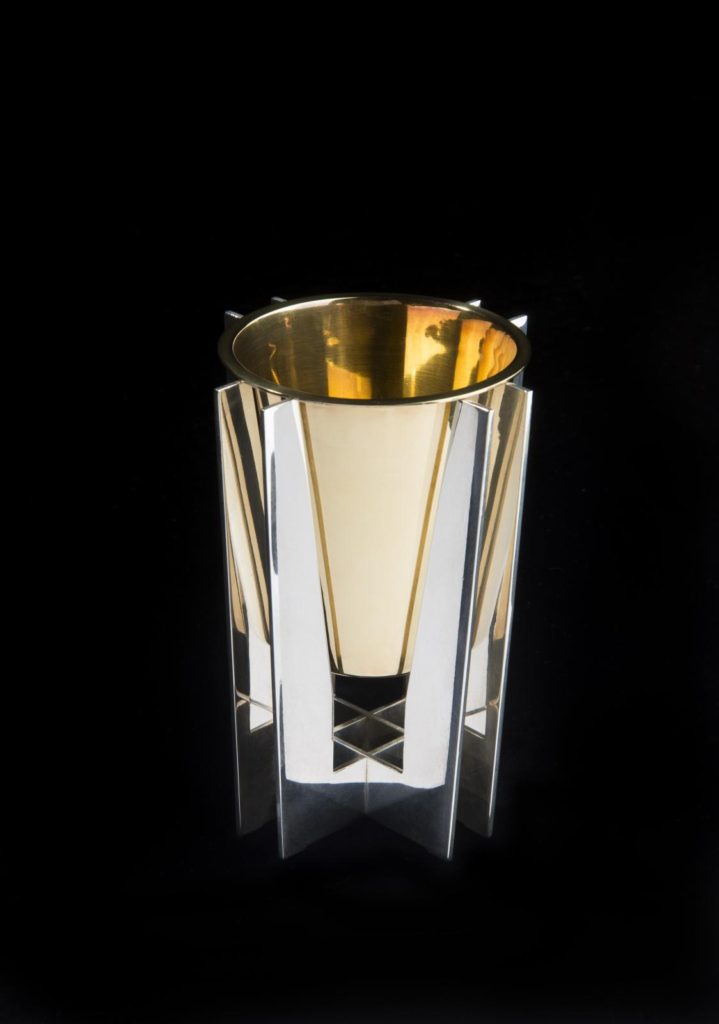
Elijah Cup
Ori Resheff (b. 1955)
Silver and gilt
Israel, 1993
Gift of Judith and Clarence Lapedes, Maureen Lynch, and Richard Lapedes to honor Ted Schwartz z”l on his significant birthday
Cincinnati Skirball Museum
Spring brings with it one of the major Jewish spring festivals, Pesach, or Passover, a seven day festival which marks the beginning of change of season and the Exodus of the Jews from Egypt. The Torah recounts how the Children of Israel were enslaved in Egypt by a Pharaoh who feared them. After many generations of oppression, God spoke to an Israelite man named Moses and instructed him to go to Pharaoh and let God’s people go free. Pharaoh refused, and Moses, acting as God’s messenger, brought down a series of ten plagues on Egypt. The last plague was the Slaying of the Firstborn; God went through Egypt and killed each firstborn, but passed over the houses of the Israelites leaving their children unharmed. This plague was so terrible that Pharaoh relented and let the Israelites leave. Pharaoh then regretted his decision and chased the Children of Israel until they were trapped at the Sea of Reeds. But God instructed Moses to stretch his staff over the Sea of Reeds and the waters parted, allowing the Children of Israel to walk through on dry land. The waters then closed, drowning Pharaoh and his soldiers as they pursued the Israelites.
The Passover seder, meaning order, retells the story of the exodus from Egypt and rich symbolism appears throughout. Near the end of the seder a cup of wine is poured for Elijah the Prophet and the front door is opened to welcome Elijah into the home. Elijah is often associated with a protective, peaceful presence and he is thought to be the prophet who will announce the advent of the Messianic age, a time of peace.
Ori Resheff (b. 1955) is a third generation silversmith from Tel Aviv. Resheff followed the path of his grandfather, Michael Filmus, and his mother, Judith Filmus Resheff, creating beautiful pieces of silver Judaica. Resheff went to on teach at the Bezalel Academy and his work can be found in museums and synagogues worldwide.