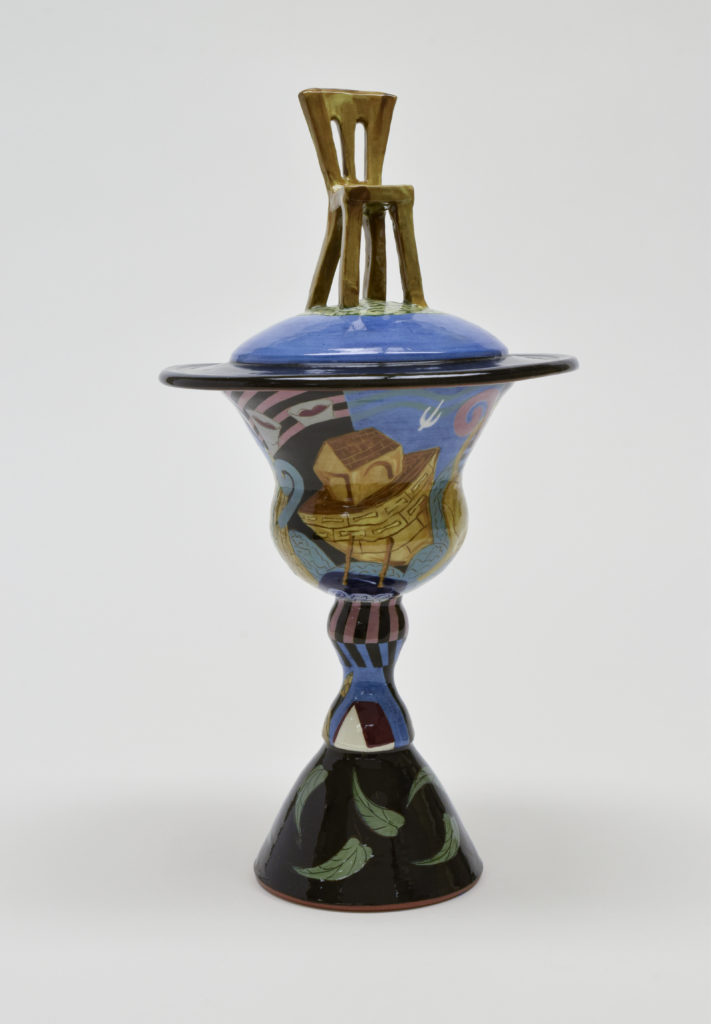
Elijah Cup
Robert Lipnick
Ceramic
United States, 1991
B’nai B’rith Klutznick Collection of the Cincinnati Skirball Museum
Cups for Elijah are used ceremoniously during Pesach, or Passover, a seven-day festival that marks the beginning of spring and recalls the exodus of the Jews from Egypt. During this holiday seders, meaning order, which retell the story of the exodus from Egypt through rich symbolism. Near the end of the seder, a cup of wine is poured for Elijah the Prophet and the front door is opened to welcome Elijah into the home. Elijah is often associated with a protective, peaceful presence and he is thought to be the prophet who will announce the advent of the Messianic age, a time of peace.
The custom of opening the door began in the second century, when Pesach eve was also called “the Night of Watching.” The door was left open as if participants were ready to leave at a moment’s notice. When it became dangerous to keep doors open, the practice changed. Now, it is more customary to leave the door open for just a few minutes.
The custom of leaving a cup of wine originates to the second century, when a disagreement arose as to whether there should be four or five cups of wine. When a decision couldn’t be reached, it was decided to have four cups to drink and an additional symbolic cup, designated as the cup of Elijah. According to tradition, the first thing Elijah will do after he returns to the Jewish people to proclaim the advent of the messianic age is to resolve all questions of Jewish law that confounded the rabbis.
The colors of Richard Lipnick’s Elijah Cup represent earth, water, and sky. Abstract imagery suggests animal and plant forms and may symbolize creation and the creative process. The fitted lid of the cup is topped with a golden chair representing charity to humankind. On Passover, this chair is reserved for Elijah but is left empty for anyone needing a meal. In discussing this work, Lipnick wrote, “In my dream, next year is a better place.”